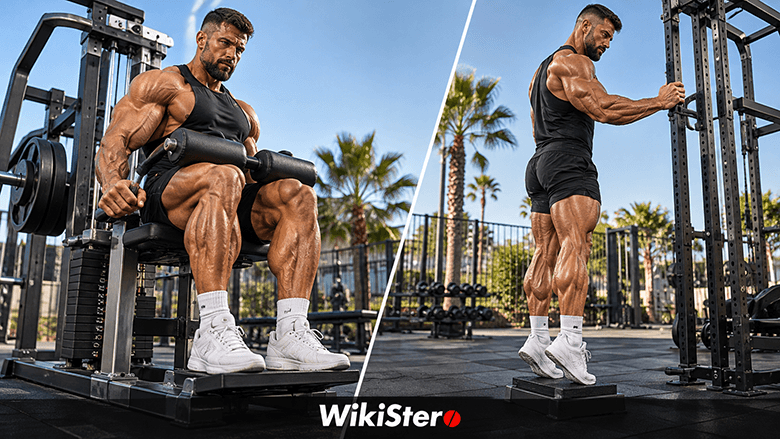
Seated vs Standing Calf Raises: Which Is Better for Bigger Calves?
If you are like many bodybuilders out there looking to build really impressive looking calves you have to pay particular attention to the type of leg workout you choose to include in your workout sessions. This is in addition to perfecting your overall training form and workout technique, as well as including progressive overload to your program to challenge your calf muscles.
When you have these in mind, you are more than likely to experience pretty good calf muscle results.
But what exercises should you add to your leg day workout regimen if you want to build rock-solid calves?
Well, there are two very effective workouts for building your calf muscles that you can adopt today and these are the seated and standing calf raises.
However, whenever you walk into any gym on leg day, one debate amongst bodybuilders that you are almost guaranteed to stumble upon is the seated vs standing calf raises debate.
While both exercises are outstanding for building calf muscles, the training stimulus offered by both workouts are slightly different in nature and your understanding of the difference in each exercise will certainly go a long way in helping you build fuller, stronger, and fully developed calf muscles.
The Seated Vs Standing Calf Raises Debate – What’s the Difference between the Two Calf Building Exercises
The main difference between the seated calf raises and the standing calf raises exercise lies in your knee(s) position which ultimately determines just how much contribution your calf muscles make to the successful execution of each of the aforementioned exercises.
Your calf muscles are made up of two primary muscles, namely; the gastrocnemius and the soleus muscles.
The gastrocnemius is a prominent calf muscle responsible for defining the overall shape and structure of the upper calves while the soleus which is located underneath the gastrocnemius muscle, contributes to the overall development of your lower leg.
Both leg workouts involve you pointing your toes downwards against resistance done in a specific movement that is known simply as plantar flexion.
However, when it comes to the gastrocnemius vs soleus muscle influence debate, the change in the position of your knees when executing the seated or standing calf raises will alter the overall emphasis that is placed on either the gastrocnemius or soleus calf muscles.
Reshaping and Building Your Calves with Standing Calf Raises
In putting the seated vs standing calf raises debate into proper context, it is worth mentioning how each of the two calf raises influence your calf muscles. In the case of standing calf raises, you get to target your gastrocnemius calf muscles as your knees tend to stay straight during the workout.
A standing calf raise is performed either by you holding proper weights as you stand in a safe and secure manner or by placing your shoulders under the pads of the machine. You then proceed to lower the heels of your feet in a controlled fashion and in such a way that your calf muscles stretch out, but in a comfortable enough way. Next, you lift your body up by standing with the balls of your feet.
As you rise to the peak of the movement, pause for a brief moment before you return to the starting position of your heels being lowered. You should try to execute controlled reps without getting into a bouncing movement. Also, avoid making use of your momentum in order to lift heavier weights. Remember, that you need controlled reps throughout your range of motion to achieve the calves you deserve.
If you are a bodybuilder looking to improve the appearance of your lower legs by promoting muscular development, then the standing calf raises should be included in your leg training program.
Target Your Soleus Muscles with Seated Calf Raises
With the seated calf raises, your knees are not straight like in a standing calf raise, but rather they are placed in a bent posture. When your knees are bent, the gastrocnemius is shortened and as a result this calf muscle does not fully contribute to the range of motion during the seated calf raises.
But on the contrary, the soleus calf muscles tend to be more active during the seated calf raises range of motion. To perform this exercise, you need to comfortably sit down on the machine even as you carefully position the resistance pad right over your lower thighs while the balls of your feet are securely placed on the machine platform.
You then proceed to gradually lower the heels of your feet and as you do, you will feel your calves stretch out. Follow this up with the raising of the weight by pushing through with the balls of your feet doing so while in full control of the entire range of motion of the calf exercise.
If you want a more complete development of your calves, the seated calf raises exercise can prove to be very valuable since the soleus calf muscles tend to contribute immensely to the thickness of the lower leg.
Which would be the Best Calf Exercises for Muscle Growth?
This is a question that is often asked during a seated vs standing calf raises debate. But the truth of the matter is that neither of the calf exercises can be said to be more superior than the other as each contributes (in their own way) to the development of your calf muscles. With variations of the standing calf raises, your gastrocnemius muscles are predominantly targeted while with the seated calf raises, your soleus muscles feature more prominently.
You should include the two calf raises exercises if you want the best results instead of favouring one over the other. As you prepare to commence your leg workout session, you can start with performing standing calf raises then you finish your leg day session with seated calf raises. It is also possible for you to train both the gastrocnemius and soleus calf muscles on separate days. However, your ability to train both calf muscles on the same day will be dependent on your workout program, the volume of your training session, and your scheduled recovery plan.
Try to concentrate on performing these exercises while maintaining perfect form and technique throughout the range of motion for both exercises with a lowering phase that is controlled even as you gradually increase your resistance or reps as you notice improvements in your strength.
Is How to Build Bigger Calves Dependent on How Often You Train Your Calves?
Building bigger calves really depends on several factors and while the frequency of your training is one crucial factor, this in itself will depend on your existing leg workout regimen, your level of bodybuilding experience, and your recovery plan.
For quite a number of bodybuilders, a calf muscles training routine done 2 to 3 times per week is ideal provided there is an allowance for adequate recovery time between highly intense sessions.
Ultimately, it is advisable that you start off sets and reps you can comfortably manage even as you slowly, but consistently raise your training volume. Also, as you plan your progressive overload to improve performance levels, don’t forget you establish a balance in your nutrition and recovery.
In addition, you should understand that having a holistic program that also involves adequate sleep, and nutrition with sufficient protein intake is how to build bigger calves going forward.
Final Verdict
Both the seated calf raises and the standing calf raises leg day workouts will complement each other in your well planned training programme. You will place emphasis on training your gastrocnemius calf muscles with the variations of the standing calf raises exercise while more emphasis is placed on the soleus calf muscles when you execute variations of the seated calf raises workout.
In order to achieve fuller, stronger, and well developed calf muscles, you will need to deliberately combine variations of these two types of calf exercises using controlled reps as well as consistently applying progressive overload to challenge your calf muscles and force them to adapt and grow.
In conclusion, the seated and standing calf raises are the best calf exercises for muscle growth you can perform today to have impressive looking calves that compliment your body structure and physique.